Skip to content



How to Fit Skirting Boards: A Step-by-Step Guide

Fitting skirting boards is a job most people can do themselves. It comes down to measuring each wall properly, getting the corners right and fixing the boards firmly. In the video below our fitter, Joe, fits a room from start to finish in two minutes. The written steps underneath follow the same order.
Measuring, cutting, fixing and finishing, in under two minutes.
Before you start
Make sure the walls are plastered, fully dry and free of dust. Fit skirting after any hard flooring that it sits on, such as laminate or engineered wood. Carpet usually goes in afterwards, which we cover in do you do skirting or carpet first. Bring the boards into the room a day or two before you fit them so they settle to its temperature and humidity.
Tools and materials
- A mitre saw or a mitre box and saw
- A coping saw, for scribing internal corners
- Tape measure, pencil and spirit level
- Grab adhesive, plus pins or screws
- Decorator's caulk and wood filler
- Fine sandpaper
Step 1: Measure each wall
Measure every wall on its own, at floor level. Never assume opposite walls are the same length, because in most rooms they aren't. Write each measurement down and check it again before you cut: measure twice, cut once.
Where you can, cover each wall with one length. Profiles such as our stepped skirting come in lengths up to 4.4 m, so many walls need no join at all. If a wall is longer, plan the join where it will be least noticed, such as behind a door or a sofa.
Step 2: Cut internal corners with a scribe
Walls rarely meet at exactly 90°, so two mitred boards in an internal corner tend to open up. A scribed joint stays tight. Cut the first board square and fit it right into the corner. Cut the end of the second board at 45° to show the line of the profile, then follow that line with a coping saw. The shaped end then sits over the face of the first board. Our guide to scribing a skirting board goes through it in detail.
Step 3: Cut external corners with mitres
For corners that stick out into the room, such as a chimney breast, cut both boards at 45° so they meet in a point. Mark the length from the corner itself rather than from your measurement, then cut slightly long and trim to fit.
Step 4: Dry fit everything
Before any glue goes on, offer each board up to the wall and check the corners close neatly. It is far easier to trim now than after the adhesive has grabbed.
Step 5: Fix the boards
Run grab adhesive in a zigzag along the back of each board, using a generous amount. Press the board firmly into place and check it sits down properly with no gap underneath. On uneven walls, or with taller boards, add pins or screws while the adhesive sets. See fitting skirting on uneven walls and can you just glue skirting boards for more on fixings.
Step 6: Fill, caulk and paint
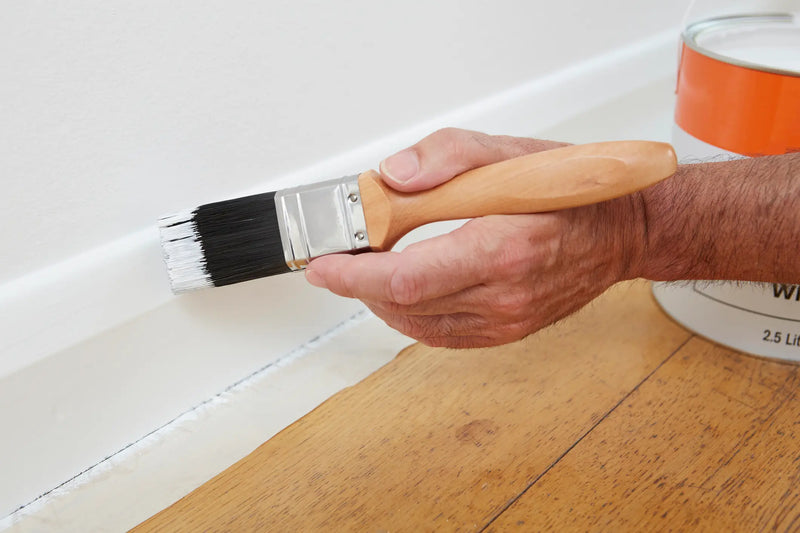
Fill the pin or screw holes and sand them flush once dry. Run a thin bead of caulk along the top edge where the board meets the wall for a clean line. Let everything dry fully before painting. Primed boards save you a coat, and we explain the order of work in should you paint skirting before or after installing.
Joining two lengths on a long wall
Use an overlapping 45° joint rather than a straight butt joint. Cut one board with an open mitre and the other with a closed mitre, glue both faces and push them tightly together. Fix both boards to the wall so the joint stays flush, then sand and fill before painting. There is more in our guide to joining skirting boards on a flat wall.
Joining two boards with an overlapping mitre.
Common problems
A gap under the skirting
Small gaps over an uneven floor can be filled with caulk. Larger ones usually mean the floor needs attention first. See should I leave a gap under skirting boards.
Curved walls and bay windows
Standard MDF won't bend round a curve. Flexible skirting boards will, and our guide to fitting skirting around a bay window shows how.
Old skirting you'd rather not remove
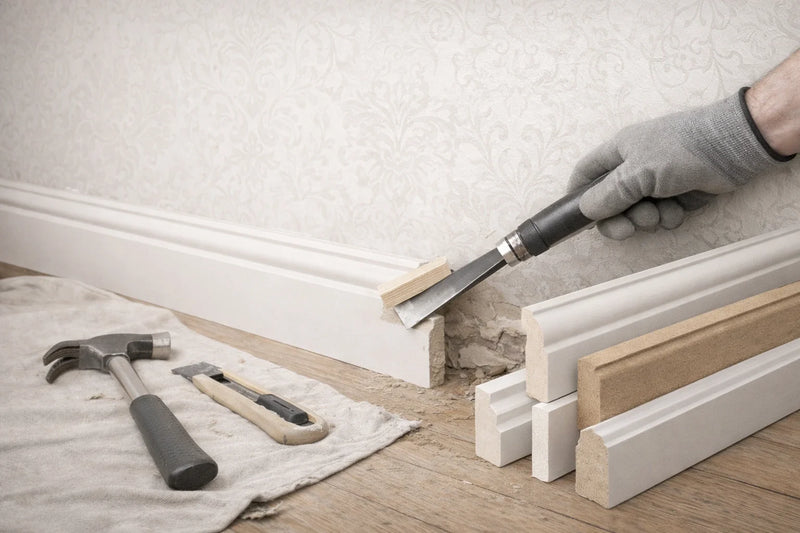
Skirting board covers fit over existing boards. If the old skirting has to come off, read how to remove skirting boards first.
Choosing your skirting
All our MDF skirting boards are made to order, primed or unprimed. For a clean modern look, try stepped skirting. For period homes, torus and ogee are the classic choices. Fitting architrave too? Our architrave installation guide follows the same approach.