Skip to content



The Character Deficit: Why Britain's New Builds Feel So Bare, and What Three Thousand Years of Architectural Detail Can Teach Us About Fixing It

There's a moment that catches a lot of new-build homeowners off guard. Not during the move itself, when the chaos of boxes and bubble wrap provides its own distraction, but a few weeks after. The sofa is in place. The curtains are up. The kitchen gadgets have found their homes. By every practical measure, the house is finished.
And yet something isn't quite right.
It's hard to name. The rooms aren't dark. They aren't cramped. The heating works, the Wi-Fi is fast, and the windows don't rattle in the wind. If you sat down and made a list of everything a home should do, this one would pass with ease.
But it doesn't feel like a home yet. It feels like a stage set waiting for someone to add the production.
Spend time on interiors forums, Reddit threads, or any Facebook group for new-build homeowners and you'll find variations of this feeling described again and again. People talk about walls that feel "too flat," rooms that feel "too tall," or spaces that feel "developer-finished" - a phrase that has become shorthand for something technically adequate but visually inert. It's a feeling that the furniture is floating in space rather than anchored to anything. That the eye has nowhere to rest.
This is not a minor aesthetic complaint. It speaks to something fundamental about how humans perceive and relate to the spaces they inhabit. And understanding it properly - from the ancient origins of architectural detail through to the economics of modern housebuilding - reveals why so many new homes feel this way, and what can realistically be done about it.
The Numbers Behind Britain's New Homes
First, it's worth appreciating the scale of what's being built. According to the National House Building Council (NHBC), 124,144 new homes were completed across the UK in 2024 - itself a figure that represents a 7% fall on 2023 and leaves the industry well short of the government's ambitions. The Labour target of 1.5 million homes over five years would require current completion rates to more than double. Even at present pace, over a hundred thousand families a year are moving into brand new properties.
These homes represent a genuine engineering achievement. Nearly all new-build homes now achieve an A or B EPC energy rating, making the average new build around 39% cheaper to run than an older home with a poor energy rating - a yearly saving of around £618. Almost all dwellings built since 2012 have an EPC rating of C or above, while the vast majority of older housing stock sits well below that. In terms of insulation, airtightness, glazing, ventilation and heating efficiency, a modern new build comfortably outperforms the Victorian terrace that many buyers might otherwise romanticise.
The HBF's most recent customer satisfaction survey, published in March 2025, found that 94% of new build home buyers would recommend their builder to a friend - the highest figure recorded in the survey's twenty-year history. These are, by almost every measurable standard, good homes.
But measurable standards don't capture everything. Energy efficiency doesn't tell you whether a room feels considered or provisional. Airtightness doesn't explain why some spaces seem to breathe and others don't. And that quiet, nagging sense that something is missing - that the home needs something else before it's truly finished - rarely shows up in a satisfaction survey sent eight weeks after move-in, before the feeling has fully taken hold.
Why New Builds Are Built Without Detail
To understand the interior character of a modern new build, you have to understand how it was produced. And to understand that, the most honest starting point is economics.
Volume housebuilding in the UK is one of the most complex logistical operations in any consumer industry. A major developer will be managing hundreds of sites simultaneously, delivering thousands of homes per year, with supply chains, subcontractors and planning conditions all pulling in different directions. The Competition and Markets Authority's major housebuilding market study, published in February 2024, documented how the sector operates on tight margins and highly systemised processes, with standardised house types, procurement frameworks and specifications that keep delivery predictable and viable across dozens of sites at once.
In that context, interior trim is not a design decision - it's a procurement category. A single skirting profile specified across an entire development reduces complexity, speeds up installation and minimises variation. One architrave across all plots means one order, one delivery, one installation sequence. Fewer ornate details mean fewer points of failure.
And then there is regulation. Building Regulations in the UK have become increasingly sophisticated and demanding - almost entirely around performance. Thermal values, air permeability, sound insulation, fire protection, ventilation rates: the inspection regime that a modern new build must satisfy is rigorous, evidence-based and vitally important. Approved Document L alone, which governs the conservation of fuel and power, runs to considerable length and has been substantially tightened in recent years.
None of it says anything about skirting boards.
Decorative interior detailing has no bearing on compliance. It doesn't influence an EPC rating. It won't affect an NHBC warranty assessment. In a regulatory environment that prioritises performance, and a commercial environment that prioritises efficiency, interior character is simply not part of the specification. It doesn't enter the calculation.
The result is homes that are excellent in ways you can quantify, and bare in ways you mostly feel.
What We Lost, and When
The interior detailing of older British homes was not primarily decorative. It was structural in the visual sense - it organised the surfaces of a room and gave them meaning.
The history of architectural mouldings in domestic interiors goes back further than most people realise. In Ancient Greece and Rome, interior spaces were framed with stone base mouldings, plinth blocks and carved surrounds that served a clear purpose: they protected walls from damage in busy spaces, concealed uneven transitions between floor and wall, and anchored the visual proportions of a room. The principles behind them - the idea that walls need grounding at the base, framing at the apertures, and softening at the ceiling - were not trends. They were responses to how human vision actually works.
Those principles travelled through centuries of European architecture and arrived in British domestic building via the Georgian period, where architects like Robert Adam formalised them into a whole language of interior proportion. In Georgian homes, skirting boards of 200–400mm were standard in the principal rooms. They were not regarded as a luxury - they were part of how a room was understood. The height of the board related to the ceiling height, which related to the room's importance in the social hierarchy of the house. Servants' quarters had simpler, thinner skirting. Reception rooms and dining rooms had substantial, profiled boards as a matter of course.
The Victorian period industrialised this tradition. Machine-tooled profiles allowed consistent shapes at scale, and skirting boards became a standard feature in the growing number of middle-class terraces and villas built during the 19th century - used to block draughts from timber floors, and often paired with heights chosen to match ceiling proportions. Victorian skirting boards were practical, but they were also a visual expression of pride and prosperity. More elaborate rooms had deeper profiles, while servant quarters had thinner, more functional skirting.
The Edwardian period softened things slightly. Skirting profiles became typically 150–180mm and more refined, with cleaner chamfered edges and softer curves. The interwar period brought further reduction, as ceiling heights lowered and housing production scaled up. Post-war volume building, driven by the urgent need to house a population devastated by the Blitz, simplified everything further.
By the time modern volume housebuilding arrived in its current form, mouldings had become optional. And in the cost-management culture of large-scale development, optional quickly becomes absent.
The Science of Why Bare Walls Feel Wrong
There is something beyond personal taste at work here. Environmental psychology - the study of how spaces affect human cognition and emotion - has accumulated substantial evidence that the way a room is detailed directly influences how safe, settled and at ease people feel within it.
Research into the neuroscience of space has identified what's sometimes called the light-from-above assumption: our visual systems, shaped by millions of years of evolution under open skies, instinctively expect light to come from above and to create shadows below. This perceptual bias, first studied systematically by Ramachandran at UC San Diego, shapes how we interpret depth and form. When a space provides the kind of shadow lines and depth variation that our visual systems expect - when surfaces aren't uniformly flat - the brain reads it as familiar and comprehensible. When everything is equally flat, equally bright, equally textured, the brain has to work harder to process what it's looking at. The result is a subtle but persistent sense of unease.
This is directly relevant to interior mouldings. A skirting board creates a shadow line. An architrave creates a frame that distinguishes the wall from the opening. A cornice at the ceiling junction creates a transition rather than a hard edge. These elements are not primarily aesthetic. They are doing perceptual work - giving the eye the variation in shadow and depth that it expects from a three-dimensional space.
Studies in environmental psychology also suggest that humans subconsciously prefer spaces where proportions fall within certain ranges - typically where the relationship between width, depth and height allows the eye to travel without losing focus. When that balance is lost, the body registers unease. An exposed wall that stretches from floor to ceiling without interruption - particularly at 2.6 or 2.7 metres - can trigger exactly this. The wall feels too present, too undifferentiated. There is nothing to divide the vertical plane and create the rhythm that the eye looks for.
This is not a matter of taste for period features. It is a neurological response to proportion.
The Skirting Board Problem in Detail
No single element better illustrates the character deficit of the modern new build than the skirting board.
In most volume new builds, a single skirting profile - typically around 70mm in height - is installed throughout the entire property. The same board in the hallway, the living room, the bedrooms, the landing. This makes complete sense from a procurement and installation perspective: one specification, one product, one price.
But 70mm at 2.6 metre ceiling height is visually underweight. It makes no claim on the wall above it. Furniture placed against a wall with minimal skirting looks untethered - the eye searches for a visual anchor at the base and doesn't find one. The room can feel more like a box than a considered interior.
Period properties understood this instinctively. In Victorian homes, skirting between 150mm and 225mm was standard in the principal rooms - not because builders had more time or money, but because the relationship between skirting height and ceiling height was understood as fundamental to how a room read. The skirting grounded the wall. It told the eye where the floor plane ended and the vertical plane began. Without it, the two surfaces simply collide.
Choosing a properly proportioned skirting board - one that relates meaningfully to the ceiling height of the room - is arguably the single most cost-effective character upgrade available to a new-build homeowner. The installation process is the same. The material cost difference is modest. But the visual effect is immediate and significant.
A well-chosen profile from MR Mouldings' skirting board collection - whether that's a clean, contemporary torus, a more substantial ogee for a room that can carry it, or a stepped profile that reads as architectural without being overtly traditional - will do something that 70mm of standard developer trim simply cannot: it will make the room feel like it was designed, rather than specified.
Architraves: The Element Nobody Talks About
Ask most homeowners what they'd change about their new build interior and skirting boards come up. Architraves rarely do - which is interesting, because they may do even more work.
An architrave is the trim that runs around a door opening, covering the junction between the door lining and the wall plaster. In a standard new build, this tends to be a minimal profile - often matching the skirting in height and weight, which is the right instinct but usually executed at a scale that leaves both elements looking thin.
What a well-proportioned architrave does is frame the door. It turns a hole in the wall into an aperture - something with intention and boundary. In a room with multiple doorways, well-matched architraves create a visual rhythm, each opening declared and considered. The eye moves around the room with more confidence.
The relationship between skirting and architrave is also important in a way that's easy to overlook. When both come from the same profile family, when they share a common design language, a room reads as coherent. When skirting and architrave look like they came from different specifications (which in a standard new build they often effectively did), the result is a fragmented visual language that contributes to that vague sense of the unfinished.
Matching architrave profiles to skirting boards is not complicated. But it's one of those details where consistency matters enormously, and where the difference between a considered interior and a developer-standard one often lies.
Wall Panelling: Why the Trend Has Staying Power
If you've spent any time on interiors-focused social media in the past five years, you will have noticed wall panelling. It's been a consistent presence on Instagram and Pinterest since around 2019, hit mainstream coverage through 2021–2023 as DIY home improvement surged during the pandemic, and shows no real sign of retreating. At this point, it's less a trend than a permanent fixture of the UK interiors conversation.
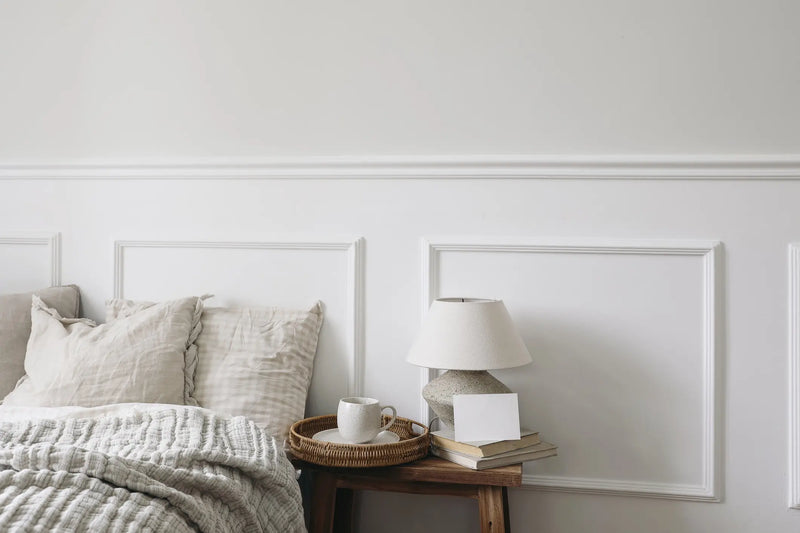
There is a reason for this that goes beyond aesthetics. Wall panelling - whether that's a full-height grid of flat moulding, a dado-height arrangement, or a panel-effect treatment on a single focal wall - addresses exactly the problem that new build interiors present most acutely: the large, flat, undifferentiated surface.
New builds are, in a perverse way, ideal for this treatment. The walls are flat and true in a way that genuinely old houses rarely are. There are no lumps from decades of replastering, no settled unevenness, no chalky Victorian lime plaster requiring sympathetic treatment. A modern plasterboard wall takes moulding adhesive cleanly and holds it well. The contrast between the panelled section and the plain wall above is crisp and satisfying in a way that's harder to achieve in older properties.
The psychological effect is significant. Panel moulding creates exactly the kind of rhythm, shadow line, and visual division that bare new build walls lack. It gives the eye structure. It divides a tall wall into proportionate sections. And because it adds depth without adding mass, it enhances without overwhelming.
The most effective approach is rarely the most complex. A simple grid of flat-profile moulding, evenly spaced and cleanly painted, does more for a room than an elaborate Victorian-style dado treatment applied without restraint. The aim is visual structure - introducing the rhythm that should have been there from the beginning - not historical mimicry.
MR Mouldings' wall panelling range is designed with new builds specifically in mind: profiles that are architectural without being period-specific, available in lengths that minimise joins, and in MDF that accepts paint without the grain-raising issues of softwood. The result, installed with reasonable care and good spacing, is a room that reads entirely differently - one where the surfaces feel deliberate rather than default.
Cornice: The Finishing Detail That Changes Everything
Of all the elements that new builds omit, cornice may be the most subtle in its absence and the most transformative in its addition.
In period properties, cornice - the profiled trim that runs at the junction of wall and ceiling - was as standard as skirting. Its job was simple and important: to ease the transition between two planes. A hard angle at the meeting point of wall and ceiling is a relatively harsh thing for the eye to process, particularly when both surfaces are white, and the angle is crisp. Cornice softens it. It creates a shadow line at the top of the wall that, like the shadow line created by skirting at the bottom, gives the vertical plane a visual boundary.
The effect on the room proportion is surprising. A simple cornice profile in a 2.6 metre room can make the ceiling feel intentional rather than arbitrary - as though the height was chosen and considered, rather than simply arrived at. It completes the room in a way that's difficult to articulate but immediately felt.
Modern cornice doesn't need to be elaborate. A restrained ogee or simple cove profile is enough to do the perceptual work without making a contemporary room feel like a period recreation. The key, as with skirting and architrave, is proportion: a profile that's scaled to the ceiling height and room scale of the space it's in, rather than applied indiscriminately from a standard specification.
Where to Start: A Practical Approach
For most new build homeowners, the prospect of upgrading interior trim across an entire property - ripping out existing skirting, fitting new architraves, adding cornice to every room - can feel overwhelming before it's even begun. But this is rarely the right approach, and it misses the point of what makes character work in an interior.
Character is not installed. It accumulates. And the most effective approach to adding it to a new build follows the same principle: make considered choices in the right places, rather than attempting a comprehensive transformation that feels effortful and looks trying.
The hallway first. This is always the right starting point. The hallway is the transitional space - the room through which every other room is entered, and the space that sets the register for the whole house. Upgraded skirting and properly matched architraves in a hallway have a disproportionate effect because every time someone moves through the house, they pass through this space. If the hallway feels considered, the house feels considered.
The living room next. This is where proportionate skirting has the most obvious effect. A main reception room with 2.6 metre ceilings and a 70mm skirting board often feels vaguely unsettled. The same room with a 150mm board has weight and anchorage. Adding a restrained cornice profile here can complete the room in a way that transforms how it reads without changing a single other thing.
A single-panel wall in a bedroom. The framed headboard wall has become one of the most popular applications of panel moulding for good reason - it's a contained project, the scale is manageable, and the effect of a defined, symmetrical panel arrangement behind a bed is striking without being overwhelming. One wall, treated thoughtfully, is enough.
Consistency above everything. The temptation when adding character to a home is to vary profiles from room to room, to mix period styles, to try different approaches in different spaces. This is almost always a mistake. Consistency of profile across skirting and architrave - using the same design language throughout - creates the sense that the interior was planned, rather than accumulated.
The one thing to avoid is over-treatment. Not every wall needs panelling. Not every room needs a cornice. Negative space is not a failure - it's part of what makes the details that are present read well. A room where every surface has been given a treatment feels busy rather than considered. The aim is to add enough visual structure that the room feels finished, and then stop.
The Wider Question
None of this should be read as a critique of new-build homes. As noted above, they are among the most energy-efficient, practically designed, and well-warranted properties in the housing stock. The 94% recommendation rate in the HBF's latest survey reflects genuine satisfaction with homes that work well, run cheaply and are built to modern standards of quality.
But there is a distinction - one that the housebuilding industry's own metrics don't capture - between a home that performs well and a home that feels like a home. Between a space that functions correctly and a space that feels settled and considered. This distinction lives almost entirely in the detail: in the way surfaces are finished, transitions are handled, and edges are defined.
Architectural trim is not a luxury category. Before homes were built against tight budgets and deadlines, architectural gestures came in the form of cornices, mouldings and ceiling features - and these were regarded as standard elements of domestic construction, not decorative extras for those who could afford them. The idea that such details are unnecessary is a relatively recent invention, born from the logistical pressures of volume housebuilding rather than from any considered position on what makes a home feel like one.
The good news - and this is the genuinely encouraging part of this story - is that character is not structural. It doesn't require planning permission. It doesn't require an architect. It doesn't require a complete renovation or even a particularly large budget. It requires thought, proportion, consistency, and the right materials.
A new build isn't lacking in potential. It has flat, true walls, modern door linings, and surfaces that respond well to paint and adhesive. In many ways, it's the ideal canvas for exactly this kind of addition. What it needs is edges - the lines that divide its surfaces into considered proportions, give the eye somewhere to rest, and turn a technically well-built house into a home that feels like someone lives in it.
Those edges are available. They're not complicated to install. And the difference they make, once you've seen it, is very hard to unsee.
MR Mouldings supplies MDF skirting boards, architraves, wall panelling and cornice profiles to homeowners across the UK, with delivery available nationwide. All profiles are primed and ready to paint. Browse the full range here.