Skip to content



How to Add Character to a New Build Home

Many British homeowners say they would choose a period property over a new build, given the option. The reason comes down to a single word: character. The ceiling roses, the cornices, the deep skirting boards, the picture rails, the sense that the walls of a room have been considered as part of a whole. These are the things that make older homes feel different from new ones, and their absence is precisely what makes so many new builds feel like temporary stops rather than proper homes.
Here's what many of us miss: character is not inherent to age. It's inherent to architecture. The reason period properties feel the way they do is not because they're old. It's because they were built at a time when the finish of a room was treated as seriously as its structure. The cornices, mouldings and profiled skirting boards were not decorative afterthoughts. They were the standard.
New builds, built to modern cost tolerances and stripped of those details at every stage, start from a deficit. But they're not without hope. A flat, even wall is in many ways easier to work with than a period wall that has been replastered six times. The bones are good. What's missing is the finish, and that is precisely where MR Mouldings comes in.
Understanding the New Build Deficit
To fix the problem, it helps to name it precisely. New builds typically leave the factory, so to speak, with the following:
-
67mm to 95mm skirting boards in a pencil round or torus profile. These are the minimum viable product of skirting. They protect the wall-floor junction from scuffs and that's the extent of their ambition. In a room with 2.4m ceilings, they look like an afterthought.
-
No cornice or coving. The ceiling-to-wall junction in most new builds is a sharp right angle filled with a bead of silicone. In period properties, this junction was always resolved with a moulding profile. Its absence is one of the defining visual signatures of a new build.
-
No dado rail. The horizontal division of the wall at chair-back height, standard in Victorian and Edwardian properties, is entirely absent from modern developer builds.
-
No picture rail. The upper section of new build walls is uniformly blank, giving rooms an unresolved, incomplete quality that no amount of art or furniture can fully address.
-
Flat walls with no panelling or surface treatment. Developer magnolia or white, perfectly smooth and perfectly characterless.
Individually, each of these absences is noticeable. Together, they create the cumulative effect that new build owners describe as lacking soul. The good news is that each one has a straightforward remedy, and the remedy is the same in every case: the right moulding in the right place.
What follows is a room-by-room guide to adding the architectural detail that turns a new build into a home that feels genuinely yours.
New Build vs Considered Interior: What Changes
|
Standard new build |
With MR Mouldings |
|
67-95mm pencil round skirting |
150-170mm ogee or torus skirting |
|
Sharp silicone ceiling junction |
Cornice or coving in appropriate profile |
|
No dado rail |
Dado rail at 90-100cm, dividing the wall |
|
Flat painted walls |
Panel mouldings creating grid or Shaker detail |
|
No picture rail |
Picture rail completing the upper wall |
|
One coat developer magnolia |
Considered paint scheme responding to architecture |
Step 01. Replace the Skirting Boards
The skirting board is the foundation of any room. It's the detail closest to the floor, seen at close range every day, and it sets the tone for everything above it. In most new builds it is the detail that most obviously signals a developer finish rather than a considered one.
Replacing standard skirting with a taller, more detailed profile is one of the highest-impact changes you can make to a new build room. The difference between 67mm pencil round skirting and 150mm ogee skirting in the same room is not subtle. It changes the visual weight of the entire wall, grounds the room properly, and immediately reads as a design choice rather than a minimum viable installation.
What to consider when choosing a skirting profile for a new build:
-
Height. In rooms with standard 2.4m ceilings, 120mm is a comfortable minimum. 150mm to 170mm looks noticeably better and gives the room the proportional weight it needs. Taller rooms can carry 200mm and above.
-
Profile. The two most versatile profiles for new builds are torus and ogee. Torus is a clean, slightly curved profile that suits both contemporary and transitional interiors. Ogee has more detail and works well in rooms with period or decorative aspirations. Chamfered or square-edge profiles suit strictly contemporary settings.
-
Consistency. The profile you choose for the skirting should run through the whole property. Changing skirting profiles between rooms creates visual fragmentation that undermines the sense of a considered interior.
Browse the complete MR Mouldings skirting board range and use the profile guide to match the right shape to your home's style and ceiling height.
Step 02. Add Coving or Cornice
Of all the things a new build is missing, the absence of coving is arguably the most immediately noticeable to anyone with an eye for interiors. The ceiling-to-wall junction is one of the most visible lines in any room, and the way it's resolved is a quiet but powerful signal of quality. In period properties it's always moulded. In new builds it's always not.
Installing coving in a new build does something that very few other interventions achieve: it lifts the room. Not literally, but perceptually. A ceiling with a resolved cornice junction reads as higher and better proportioned than the same ceiling with a bare silicone bead. The moulding draws the eye upward and outward, expanding the apparent scale of the room.
For new builds, the most effective coving choices tend to be:
-
A simple cove or chamfer profile for contemporary new builds where clean lines are the priority. These resolve the junction elegantly without adding ornament.
-
An ovolo or ogee cornice for new builds being given a more period-influenced treatment. These add visible detail and work particularly well in conjunction with panel mouldings on the walls.
-
A deeper, more decorative profile in principal rooms, living rooms and master bedrooms, where the additional detail is appropriate to the scale and purpose of the space.
View our coving and cornices page
Step 03. Panel the Walls
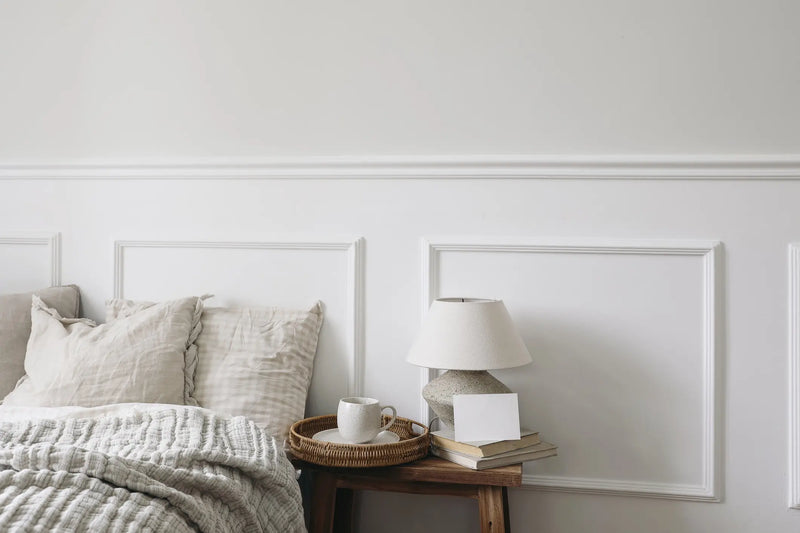
If skirting is the foundation and coving is the ceiling resolution, wall panelling is the middle act that ties everything together. It's also the intervention that generates the most dramatic visual change, because it transforms a flat, blank developer wall into a surface with genuine depth, texture and personality.
New builds are, counterintuitively, among the easiest properties to panel. The walls are flat, plumb and consistent. There are no layers of old paint, no uneven plaster, no previous mouldings to work around. The surface is exactly what you'd want before applying panel mouldings: clean and ready.
The styles that work particularly well in new build contexts:
-
Grid or Shaker-style panelling is the most versatile choice and the most widely saved on Pinterest. It suits new builds of every style, from contemporary to transitional, and works in every principal room. The structured grid creates the visual architecture the walls are missing.
-
Half-height dado panelling runs from the skirting to the dado rail and creates a strong lower section to the wall. Particularly effective in hallways and dining rooms, and one of the most authentic ways to give a new build the feel of a considered, period-influenced interior.
-
Full-height panelling in bedrooms or living rooms creates an enveloping, cocooning quality. Painted in a deep, saturated tone it becomes the dominant feature of the room, and in a new build that typically needs a dominant feature, this is a powerful choice.
Step 04. Layer with Dado and Picture Rails
Dado and picture rails are the horizontal lines that give a wall its structure and scale. In a period property they're always present, at least in theory, because they were standard architectural practice for most of British domestic building history. In a new build they're entirely absent, and their absence contributes significantly to the sense that the walls are unresolved.
A dado rail at around 90 to 100cm from the floor divides the wall into two zones and creates an immediate sense of proportion. It's the architectural foundation for the two-tone paint treatments and panelling styles that dominate Pinterest's most-saved interior boards right now. Without it, those paint treatments look unanchored. With it, they look considered. Browse the MR Mouldings dado rail range.
A picture rail in the upper section of the wall, typically positioned around 30 to 40cm below the ceiling junction, adds a second horizontal line that completes the layered architecture of the wall. It allows artwork to be hung without wall fixings, which is a practical benefit, but its visual contribution is more significant: it defines the upper portion of the wall and gives the eye a clear reference point for the height of the room.
The combination of dado rail, panel mouldings below, and picture rail above is the treatment that most closely replicates the layered wall architecture of a Victorian or Edwardian interior in a modern property. Done with the right profiles, painted with intention, it is the transformation that makes new build owners stop and realise their house finally feels like a home.
Step 05. Start With the Hallway
If you're undertaking the moulding work room by room rather than all at once, the hallway is the right place to start. It's the smallest space, which means the material investment is lowest and the project scope most contained. But it's also the first room every visitor sees and the space you and your household pass through more times a day than any other. The impact of a transformed hallway is felt disproportionately relative to its size.
The Complete Picture
Each of the steps above does significant work on its own. A skirting upgrade alone changes a room. Coving alone lifts it. Panelling alone transforms it. But the complete picture, the room where all five interventions have been made together and the paint scheme has been chosen to respond to the architecture, is something categorically different.
It is a room that could belong in a Victorian townhouse or a contemporary city apartment. It has the permanence and quality of a space that was designed rather than assembled. And it sits, without any apology, in a new build that six months earlier looked exactly like every other new build on the development.
That is what mouldings do when they're chosen well and applied consistently. They don't decorate a room. They give it architecture. And once a room has architecture, everything else follows.
To start planning your new build transformation, browse the full MR Mouldings range or get in touch with our team for guidance on profiles, heights and the right approach for your property.