Skip to content



Why Skirting Boards and Mouldings Are Having a Moment

By Adam McGrory, Director, MR Mouldings
Something has shifted in the way British homeowners think about their walls.
For the better part of four decades, the prevailing instinct in interior design was to strip back, simplify, and remove. Cornices were boarded over. Dado rails were pulled off and the holes filled. Skirting boards shrank to the smallest size the builders' merchant stocked. The goal was clean, unbroken surfaces - walls as a neutral backdrop, detail as clutter.
That instinct has reversed, quietly at first, and now with real momentum.
Over 1,700 dado rails were sold by MR Mouldings in the first half of 2025 alone, with weekly orders growing from just two in early January to a consistent five or six per week by late spring. Searches for bedroom panelling ideas now exceed 3,000 a month in the UK. Dado rail ideas attract over 1,200 monthly searches. Wall panelling ideas for the living room generate 600 more. These are not niche numbers. They represent a mainstream shift in how people are thinking about the rooms they live in.
The question worth asking is not just what is trending - but why. What does the return of architectural mouldings actually say about where interior design is heading, and what does it mean for the homes it is happening in?
The forty-year gap
To understand why mouldings are back, it helps to understand why they disappeared.
The post-war period brought with it a new philosophy of domestic space. Modernism, in its filtered-down popular form, equated simplicity with progress. The ornate detailing of Victorian and Edwardian interiors - the cornices, the dado rails, the deep skirting boards, the picture rails - came to be read as fussy, old-fashioned, and difficult to maintain. As new housing was built with lower ceilings and simpler construction methods, the architectural grammar that had made those details proportionally necessary simply stopped being built in.
By the 1980s and 1990s, the renovation booms that swept through period housing stock largely finished the job. Original mouldings were removed, boarded over, or replaced with minimal substitutes. The 70mm skirting board became the default across properties of every era and every ceiling height.
What was lost was not just decoration. It was a system of visual structure - the way a room's details anchor the eye at the base of the wall, mark the division between surfaces, and give a space its sense of being intentionally composed rather than merely constructed.
What changed
The revival has not come from one direction. It has arrived from several at once, which is what gives it staying power rather than the feel of a passing trend.
The first driver is the improve-rather-than-move shift. With 33 per cent of UK homeowners now choosing to delay moving and improve their current homes instead, and 51 per cent having renovated in 2024 at a median spend of over £21,000, the investment going into existing properties is substantial. Homeowners spending that kind of money on a renovation want it to look finished - genuinely finished, not just painted. Architectural details are the difference between a room that looks decorated and one that looks designed.
The second driver is social media. Pinterest and Instagram have made the interiors of well-designed period homes more visible and more aspirational than at any previous point. The grandmillennial aesthetic - a self-aware embrace of traditional detail in contemporary spaces - has introduced dado rails, picture rails, and deep skirting boards to an audience that had no prior frame of reference for them. Industry analysis found that searches for "coving" increased by 850 per cent in the UK in a single year, while sales of decorative mouldings including dado rails, picture rails, and panelling cladding rose by 19 per cent year on year.
The third driver is material availability. As we explored in our guide to skirting board height, primed MDF has transformed access to period-style profiles. Details that once required specialist joinery and solid hardwood are now available at accessible price points, in consistent quality, with fast delivery. The practical barrier that kept mouldings out of most renovation budgets has largely gone.
The details that are coming back - and where they work
Not everything is returning equally. The revival is selective, and the choices people are making reveal something interesting about the aesthetic they are actually after.
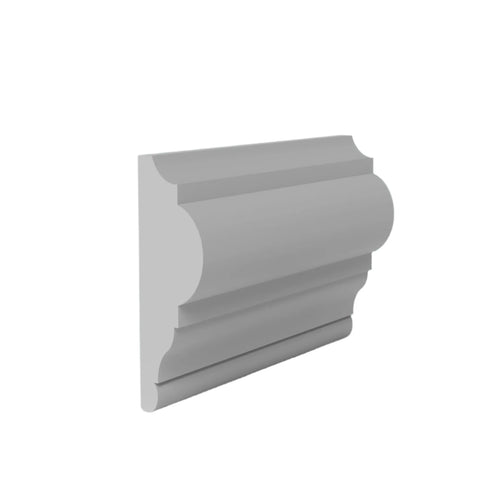
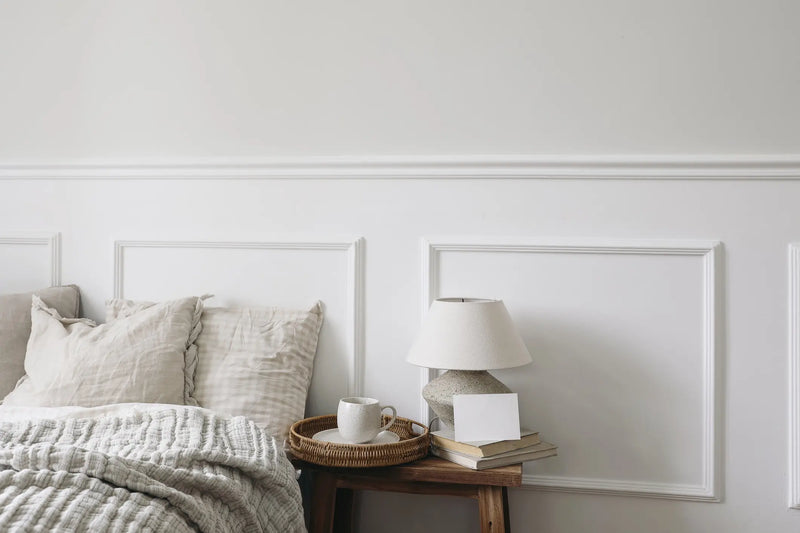
Dado rails are the standout. They offer the flexibility of being both decorative and practical, and are becoming a popular hallway must-have again - though their appeal has spread well beyond hallways. In living rooms, they are being used to divide bold colour blocking: a deeper, richer tone below the rail and a lighter shade above. In bedrooms, they provide the upper border for wall panelling arrangements. In dining rooms, they mark the transition between panelled lower walls and plain painted uppers.
The choice of profile matters more than most people expect. A deep, heavily moulded dado rail suits a Victorian or Edwardian property with high ceilings and original features. A simpler, slimmer profile reads better in a modern room where the goal is structure without weight.
Wall panelling has been the gateway detail for many homeowners - the entry point into thinking about walls as composed surfaces rather than blank planes. It is the decorative Boiserie style that is standing out to designers, allowing walls to be embellished with panel moulds and dado rails set as a single frame or a double panel, either a metre high or full height. Panel moulds used in combination with a dado rail create a framed arrangement that gives a room its vertical structure and is one of the most searched interior combinations in the UK right now.
Picture rails have followed a slightly different path. Their revival is partly aesthetic and partly practical - a growing reluctance to drill into walls at a time when people move more frequently and landlords are stricter about making good. Both the ovolo and architectural profiles suit period properties, while simpler options work equally well in modern rooms.
Skirting boards are the detail where the change is most visible in raw product terms. The shift is toward height - homeowners are increasingly choosing boards at 145mm, 170mm, or taller, rather than the 70mm default that dominated for decades. The proportion argument is straightforward: a taller board anchors the base of the wall more convincingly, particularly in rooms with higher ceilings. The full skirting board range covers everything from pencil round and bullnose for modern interiors to Victorian ogee and torus for period properties.
Architrave is the quietly overlooked part of the conversation. Homeowners who have invested in getting the skirting and dado right are increasingly noticing that the trim around their doors undermines the overall finish - chipped, dated, or simply the wrong profile for the room it sits in. For those who do not want the disruption of full removal, our recently launched architrave covers in traditional, modern, and hockey stick profiles address exactly this scenario.
The new build question
One of the most interesting dimensions of this trend is where it is happening. The revival of architectural mouldings is not confined to period properties - it is, if anything, more active in new builds and modern interiors, where the walls have no existing detail at all.
The versatility of mouldings means they can instantly add character to any room in a newer home where architectural designs rarely exist, and in an older property they create a luxurious feel that complements what is already there. For a homeowner in a new-build property with 2.4-metre ceilings and plain plasterboard walls, a dado rail at 900mm, wall panelling below it, and a correctly proportioned skirting board transforms a room that was designed as a blank canvas into something with genuine character.
This is not about replicating a period look. A clean flat-profile modern skirting board or a simple modern architrave in a new-build context is a contemporary choice - it uses the logic of architectural detail without its historical costume. The detail gives the room structure. The style of the detail is determined by the room it sits in.
What it means for how you approach a renovation
If there is a practical takeaway from this shift, it is this: the finishing details are no longer the afterthought at the end of a renovation. They are part of the design decision, and they deserve the same level of consideration as the paint colour or the floor covering.
The order in which most people think about a room - walls, floors, furniture, and then trim if there is anything left in the budget - tends to produce rooms that look almost right. The rooms that genuinely work tend to have been thought about the other way around: what is the structural logic of this space, how do the details define its proportions, and then what colour do we paint it?
The return of architectural mouldings is, at root, a return to that way of thinking. And given the volume of renovation activity currently underway in UK homes, it is a shift that is likely to continue well beyond the current cycle.
If you are starting to think about how mouldings might work in your home, our skirting board range, dado rails, wall panelling, architrave, and picture rails are a good place to start. If you are not sure what works for your specific property or ceiling height, our skirting board height guide covers the proportional principles in detail.
Adam McGrory is a Director of MR Mouldings, a UK supplier of primed MDF skirting boards, architraves, dado rails, cornices and wall panelling.
Sources
-
Dado Rails Are Quietly Becoming a Must-Have in UK Home Renovations, National World
-
Introducing the architectural-luxe interiors look, Homes Ad-Hoc
-
2025 UK Houzz & Home Study, KBB Focus
-
Home Improvement Statistics UK 2026, Primethorpe Paving
-
Hallway dado rails are becoming a major trend, Ideal Home
-
What are the latest trends in wall panelling?, Kitchens, Bedrooms & Bathrooms