


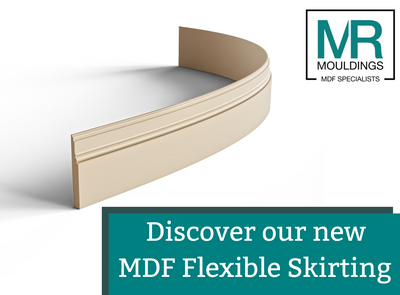
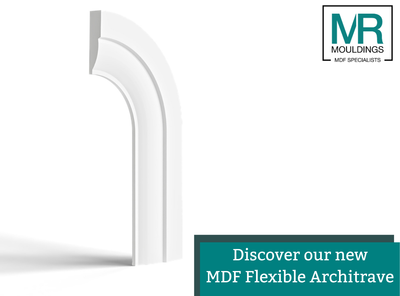


What is Reeded Architrave?
Reeded architrave is a door frame moulding with a series of parallel convex ridges - known as reeds - machined along the face of the board. Where a torus profile has a single curved projection and an ogee has an S-shaped curve, a reeded profile repeats that detail multiple times across the face, creating a more complex, textured cross-section that reads differently at every angle of light.
It is a profile with a long history in British architecture - found in Georgian and Regency interiors as a counterpoint to fluted columns and pilasters - and one that has returned strongly to contemporary interior design as homeowners look for profiles that offer more than the standard pencil round or torus of a new-build specification.
See how reeded architrave works alongside our Victorian architrave and ogee architrave collections for a fully considered door surround.
Single Reed Architrave
The single reed profile carries one prominent central ridge flanked by flat shoulders on either side. It is the more restrained of the two profiles - the ridge is bold enough to read clearly across a room but the overall cross-section remains relatively slim. A strong choice for hallways and living rooms where a decorative door surround is wanted without the profile becoming the dominant feature of the space.
Pair with our plinth blocks and rosettes at the base of the door frame for a complete and considered surround.
Double Reed Architrave
The double reed profile carries two parallel ridges across the face, creating a more complex shadow pattern and a richer visual texture than the single reed. At close range the two ridges are clearly distinct. Viewed from across a room the profile reads as a single bold detail with pronounced depth. It suits larger rooms and taller door frames where the additional visual weight of a double reed profile is in proportion with the scale of the opening.
Works particularly well alongside our traditional skirting boards in period and heritage interior schemes.
Why MDF for Reeded Architrave?
The reeded profile relies entirely on the precision of the machined ridges for its effect. On pine, wood grain runs across the face of the board and interrupts the clean lines of each ridge - visible as texture variation under paint, particularly in raking light. Over time, pine also moves with seasonal changes in humidity, causing the ridge detail to distort slightly as the board expands and contracts.
MDF eliminates both of these problems. The face is homogeneous and grain-free, so the ridge profile reads exactly as machined from one end of the board to the other. It is also dimensionally stable, so the cross-section holds its shape year-round regardless of the conditions in the room.
For the full range of MDF architrave profiles, browse our architrave collection.
How to Fit Reeded Architrave
Reeded architrave is fitted in the same way as any standard architrave profile. Mark a reveal line around the door lining, mitre the head piece and two legs at 45 degrees at the top corners, fix with grab adhesive and panel pins, and secure the mitre joints with a small amount of adhesive while pinning through the face. Fill pin holes, caulk the back edge where the architrave meets the wall, and apply your chosen topcoat. The pre-primed surface requires no additional priming before painting.
For complementary door frame products, browse our door linings and architrave blocks.