




Cornice or coving - what's the difference?
The terms are used interchangeably in everyday conversation, and the products often overlap, but there's a technical distinction worth knowing before you order.
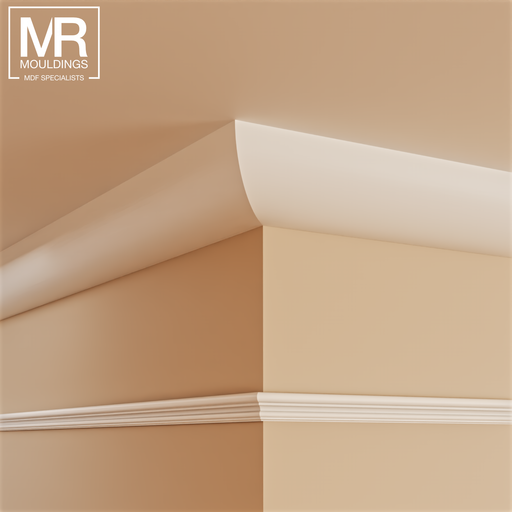
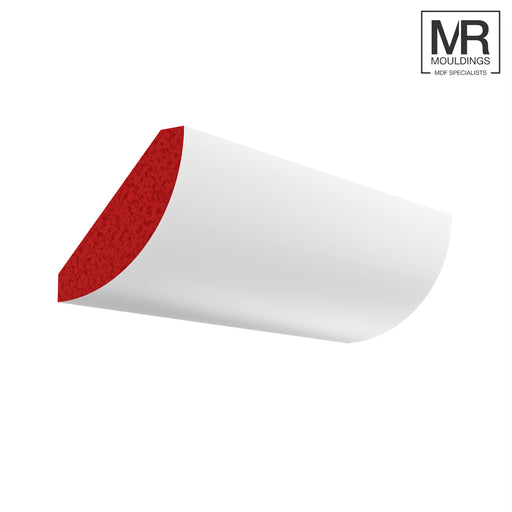
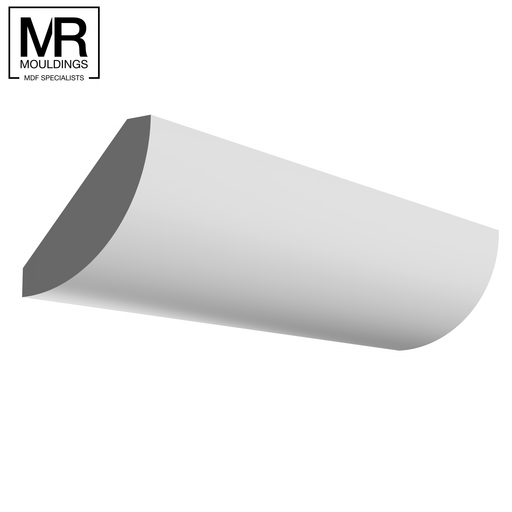
Coving is the simpler of the two: a plain curved or angled moulding that bridges the angle between wall and ceiling. It has no face detailing - its job is to create a smooth visual transition and hide any gap or crack at the ceiling line. It's the standard choice in modern and Edwardian properties where the detailing is minimal.
A cornice is more architecturally considered. It typically has a shaped or moulded face - stepped, curved, dentilled or otherwise detailed - that reads as a designed element rather than just a filler. In period properties, the cornice was part of the classical order of the room: it carried visual weight, defined the ceiling zone, and was proportioned against the height of the room and the depth of the skirting below. For most renovation work in Victorian and Georgian properties, a cornice is the right specification rather than plain coving.
Profiles and period styles
Our standard MDF cornice range covers the profiles most commonly specified for period renovation work and new build schemes with traditional detailing. The Regency profile - our most popular - has a deeply stepped and moulded face suited to Victorian and Edwardian reception rooms. Plain and ovolo profiles are available for rooms where a lighter touch is required.
Victorian cornices were typically large by modern standards: 100mm to 150mm on the wall leg was common in main reception rooms, with deeper and more elaborate profiles in grander properties. If you're working in a period room and the ceiling height is 3m or above, a larger cornice profile will read correctly in proportion. A 75mm cornice in a high-ceilinged Victorian room can look undersized - it's worth sizing up.
If you're specifying cornice alongside skirting boards and architrave for a period room, our Victorian skirting boards range uses the same period-appropriate profiles, and the two are designed to work as a coherent scheme.
Flexible cornice for curved walls and bay windows
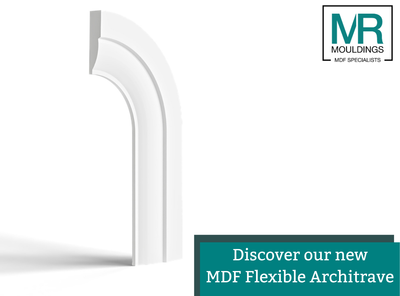
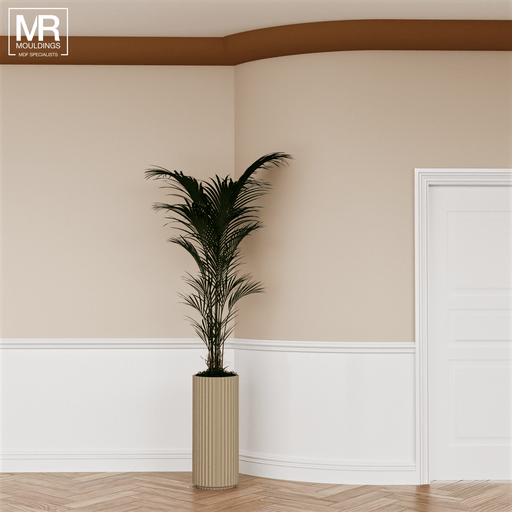
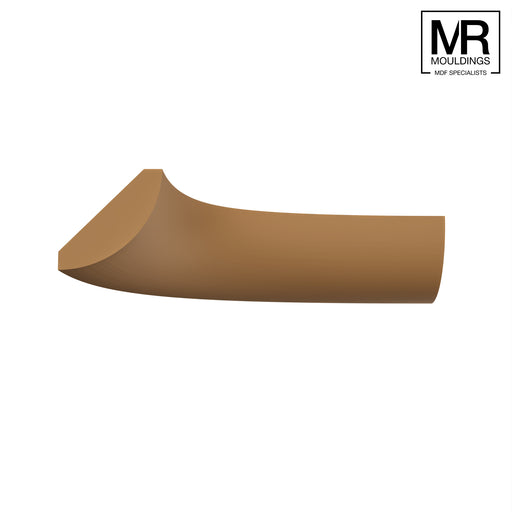
Standard MDF cornice runs in straight lengths. For rooms with curved walls, bay windows or non-90-degree ceiling junctions, the flexible cornice and coving range is manufactured to bend to the wall line. Bay windows are the most frequent application - the cornice follows each facet of the bay rather than mitre-cutting across it, which gives a cleaner result and removes a tricky cut on site. For gradual curves with a large radius, the standard MDF range with careful mitring may still work; for tighter curves the flexible version is the right specification.
We also supply flexi MDF cornices as a separate range for projects where flexibility is needed across a wider profile selection.
Fire rated cornice for commercial and multi-occupancy projects
Where a project specification calls for fire rated materials - commercial interiors, HMOs, hotels, schools and similar - our fire rated MDF cornices are manufactured from FR MDF board to meet the relevant fire performance requirements. Profile and finish are identical to the standard range. If you're unsure whether your project requires FR specification, the building regulations documentation or your main contractor's spec sheet will confirm the requirement.
Fixing and installation
MDF cornice is fixed with a combination of proprietary coving adhesive and, where needed, mechanical fixings into the wall and ceiling. The standard method is to run adhesive along both back faces, press the cornice into position and hold or pin while it sets. On masonry walls, screws at 600mm centres into plugged fixings give additional security for larger profiles. All our profiles are supplied primed, so they're ready for caulking, filling and painting once fixed.
The most common challenge on site is internal and external corners. Both can be cut with a mitre saw or mitre box; the angles vary depending on the room geometry, so it's worth measuring carefully rather than assuming 45 degrees throughout. Leave a small gap at corners for caulk - it will give a cleaner finish than a dry butt joint and accommodates any slight movement in the building fabric over time.
MDF vs plaster cornice
Original cornices in period properties are almost always lime plaster or gypsum - either run in situ on the ceiling or cast as individual lengths and fixed in sections. They're irreplaceable in a conservation context and worth retaining wherever possible. The issue arises when sections are damaged or missing: matching plaster profiles exactly requires specialist casting, is expensive, and lead times are long.
MDF is the practical alternative for most renovation and new build work. It profiles consistently, takes paint cleanly without grain or casting marks, and is available to a short lead time cut to length. For rooms that will be painted rather than limewashed or decorated in a conservation-grade finish, the visual result is essentially identical once the cornice is on the wall. The weight difference also matters: MDF cornice is significantly lighter than plaster, which simplifies installation and puts less stress on the fixing points.
MDF Cornices | Flexi MDF Cornices | Flexible Cornice & Coving | Fire Rated MDF Cornices | Victorian Skirting Boards | Picture Rails | Dado Rails | Wall Panelling